Mobility
Mobility and good turnover are highly correlated. Good turnover creates opportunities for mobility, and planned proactive mobility leads to good turnover. However, not all mobility is equal. A lack of proactive planned mobility can lead to a rash of reactive unplanned mobility, which can be harmful to a firm.
If done right, mobility is good for the employee and good for the organization. To be good for the employee, mobility to a new position must satisfy some key conditions:
It should be aligned with the employee's goals,
The employee should have the skills and experience to succeed in the role, but just barely. That is, the employee must be stretched to succeed,
The employee should learn new skills, have new experiences, and meet new people, and
These new skills and knowledge should contribute to the employee's eventual upward mobility.
Mobility can be beneficial to the employee if it is upward (a promotion), lateral, or even downward. The test of good mobility for an employee is whether the employee will be challenged in the new role, and will acquire the skills, experiences and network that immediately or eventually contribute to his or her career advancement.
Good mobility helps the firm in several ways as well. First, if the mobility is good for the employee, then it will lead to a satisfied, striving employee for the foreseeable future. Nothing makes an employee happier than the feeling that the work they are doing is contributing to their advancement. Second, good mobility leads to a steady stream of well-suited employees for openings as they arise. The key to successful internal mobility is understanding and recording each employee's career aspirations and to plan and prepare constantly for mobility to available positions. The tools for mobility analysis are mobility candidates, mobility chains and mobility screening.
Mobility candidates, as the name implies, are employees who are candidates for filling roles in a firm. In other words, each employee in the firm should have several mobility candidates who could fill their position if they were to leave the firm or move to a different position. The mobility candidates should be judged by the conditions listed previously. For example, if two employees are at the same level, have approximately the same skill set, have the roughly the same performance ratings, have been in their roles for the same amount of time, and both are ready for their next assignment, then one employee is not a good mobility candidate for the other. They each have the requisite skills, but they won't be stretched and they won't learn new skills or have new experiences. It is not enough that a mobility candidate is able to succeed in a role – he/she must also develop in their new role.
Most managers and Personnel departments have an informal or formal system for identifying and listing mobility candidates for each employee, or for employees deemed critical or high risk (for departure). However, less commonly found are organizations that have identified mobility chains and associated strong links, which are those employees that appear in several mobility chains. As shown below, when an open position is filled it often leads to a chain reaction of internal mobility movements within an organization. A mobility chain is a planning tool that models these movements in advance.
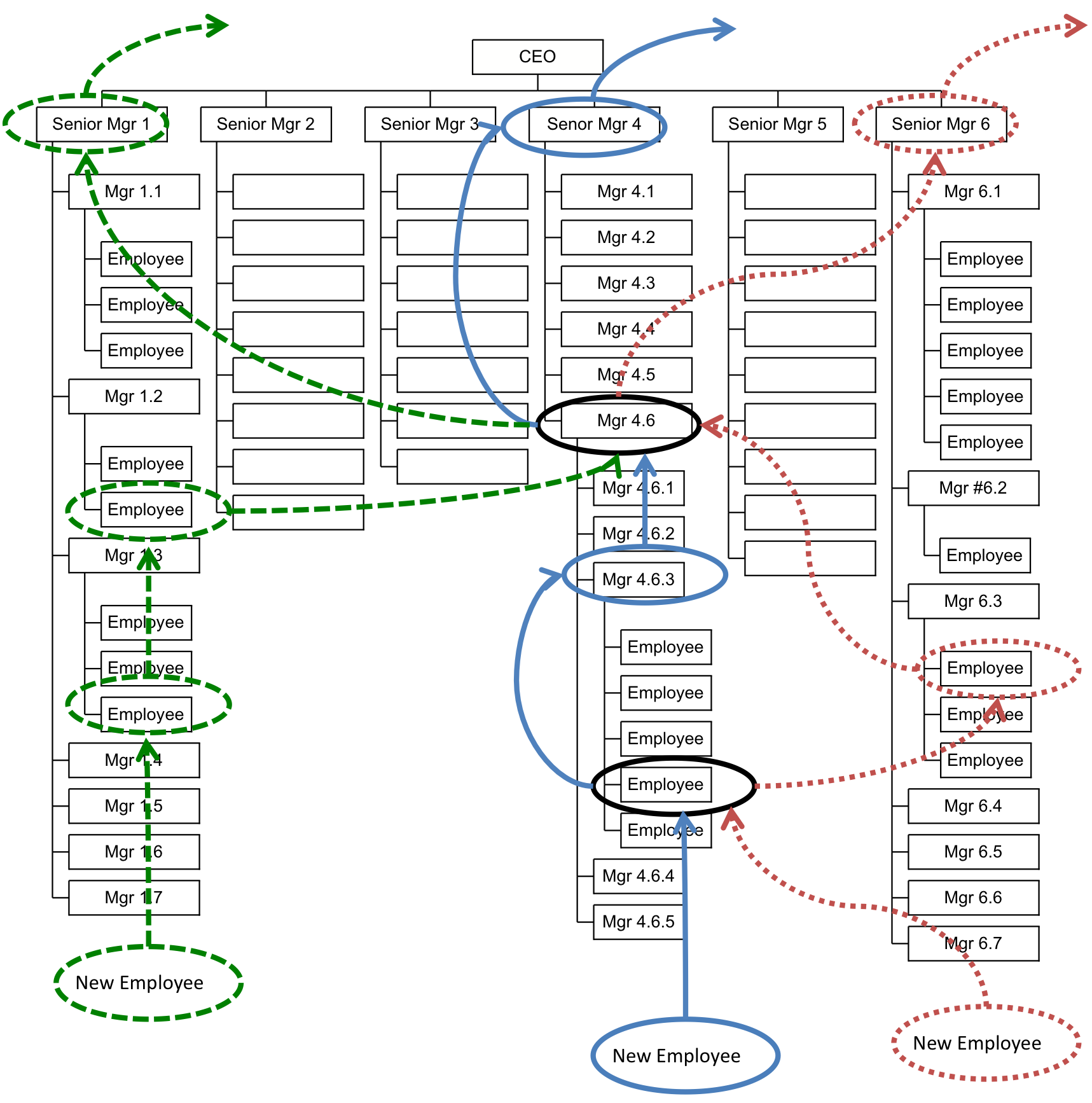
The diagram above shows mobility chains for three senior managers. If Senior Manager 1 departs, then the best alternative to replace him/her is considered to be Manager 4.6, who would be replaced by an employee reporting to Manager 1.2, and, so on, down to a New Employee. There are similar chains for Senior Manager 4 and 6. If you study these mobility chains it is evident that Manager 4.6 is included in three chains and an employee reporting to Manager 4.6.3 is included in two chains. They are strong performers and they are also strong links in our mobility chains.
Identifying mobility candidates is typically a job for managers and for their Human Resource colleagues. Identifying mobility chains and their strong links is a job for computers and their software. You can see that chains can become a bit complicated for our simple example; they become extremely complicated for an organization of any significant size. Once a strong link is identified, such as Manager 4.6, alternatives need to be identified to ensure that the organization can produce non-intersecting mobility chains for key employees in the organization.
Employees, guided by their Human Resources department, often identify their mobility candidates. Typically each employee lists others in the organization that could take his or her job if the employee were to move to another role. Then the employee's HR generalist reviews the list, may suggest other candidates, and these lists are shared with other HR generalist. This approach may produce non-optimal results if the firm does not have a thorough sourcing process. If the mobility candidates are limited to the employees known by the employee, then there may be exceptional mobility candidates in other parts of the firm that are never put on the list of candidates; mobility screening is a more systematic approach to identifying mobility candidates throughout the firm.
Mobility screening scans the employee hierarchy searching for employees who are candidates for internal mobility. These employees will have been in their current role for sufficient time and they will have consistently high performance ratings. This screening will provoke discussions about the mobility of employees who are overdue for advancement in the organization and are becoming a growing risk for defection to another firm where opportunities for advancement exist. Furthermore, mobility screening may be used to create a mobility chain for a candidate. Used in this manner, mobility screening foreshadows the moves that will likely happen if the firm does not take action proactively.
We have described good turnover, mobility, and the tools for ensuring that good turnover leads to healthy mobility, namely mobility screening, mobility chains and strong link candidates. To set these mobility and turnover processes in motion, we need to create openings in the firm for candidates to move into – this is the role of talent upgrading.